About the book
A seven-year journey to become a family
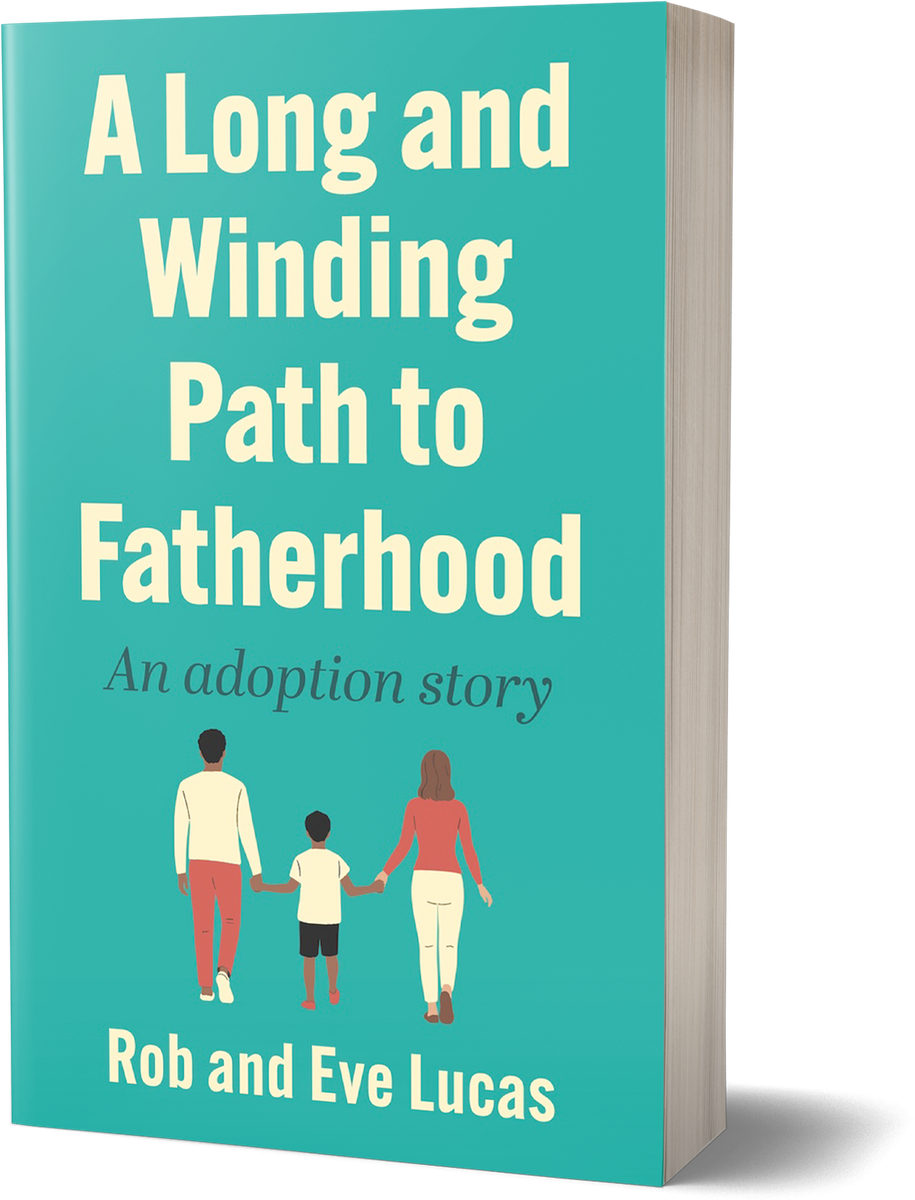
A Long and Winding Path to Fatherhood is the true story of how a husband and wife became parents to their adopted mixed-race son. Told from the male perspective, it is a heartfelt account of a seven-year journey through infertility, adoption, setbacks and finally, the life-changing moment of becoming Dad.
Raw, honest and hopeful, this is a story for anyone walking their own winding path to parenthood – and for those who believe that families are built in many beautiful ways
Key Themes

A male perspective on adoption
An honest, first-hand account sharing rarely heard experiences and emotions from an adoptive father
A mixed-race family story
Their story of how they completed their family by finding their mixed-race son through adoption

An honest and inspiring journey
From heartbreak and setbacks to laughter and joy – a story of perseverance, hope and finding their way

About the Authors
Rob & Eve Lucas
Rob Lucas is a passionate Arsenal supporter, an all-round sports fan, a keen walker and a dedicated Dad. He navigates a successful in career in finance with family life.
Eve Lucas is a writer, an event manager, an intrepid traveller and a devoted Mum which she combines with a burning desire to finish her first novel.
Contact us: RobandEveLucas@gmail.com
From the Blog
The story continues...
The winding path of parenthood carries on
 Adoption Reflections
Entertaining adoption
It’s not all academic tomes and documentaries: books, movies, TV shows and other fun and irreverent entertainment that happens to be about adoption!
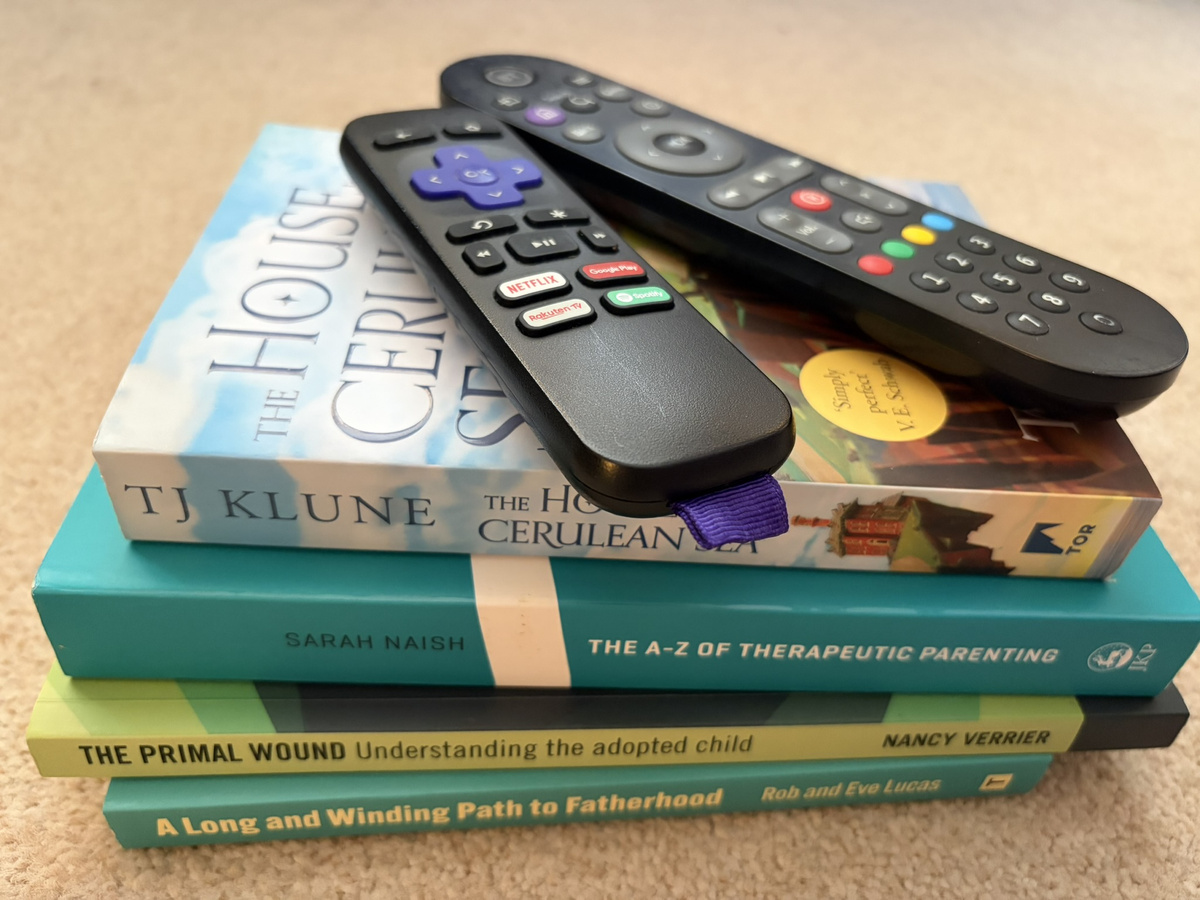
During the afore-mentioned long period of application to be approved to adopt, adoption agencies strongly recommended applicants to carry out their own research about adoption, in the form of books, documentaries, podcasts and any other stuff like that which provides insights and experience of being adopted and becoming adopters.
But in addition to the educational hard-hitters – weighty venerated tomes such as The Primal Wound by Nancy Verrier, Building the bonds of attachment and/or Parenting a child with emotional and behavioural difficulties, both by Dan/Daniel A. Hughes, and The A-to-Z of therapeutic parenting by Sarah Naish – there is also a fair bit of quality, fun, entertaining stuff out there which happens to include adoption as part of the story being told.
Our stand-out favourite is the sitcom Trying on AppleTV+ (also now on BBC iPlayer). It came out just as we were starting our application process, and brought to life in front of our eyes so much that we had so far only read about. Plus, it’s funny! There are 5 seasons as well, so you can really get into it.
I also love the movie Instant Family with Mark Wahlberg and Rose Byrne. Even thought it’s set in the US the process isn’t that different, and it’s now my go-to wind-down movie when I need something familiar and feel-good.
Sitting between a movie and a series there is the three-part BBC drama, Lost Boys and Fairies, a heartbreaking and hugely endearing story of 7-year-old Jake’s adoption. We’ve only watched this once, and writing about it now makes me feel it’s time for a re-watch this winter.
I am a voracious reader of contemporary novels, and have stumbled upon adoption in books I found myself reading for totally different reasons, including:
Away with the Penguins, Call of the Penguins and Gone with the Penguins by Hazel Prior
The main character octogenarian Veronica McCreedy gave up her son for adoption when she was very young and never managed to connect with him in later life, but she does connect with his son, her grandson Patrick, who in turn never really knew his father either. It was Patrick’s emotional difficulties as an adult still struggling with the impact of his early life experiences which really struck me. And the penguins. Plus the other characters too. It’s a great story, and I highly recommend them all.
The House in the Cerulean Sea and Somewhere Beyond the Sea by T J Klune
These two ‘cosy fantasy’ novels centre around an unusual orphanage and its guardians, who totally overstep the initial job role and very much become parents to the kids in their care, and create an unconventional but highly recognisable family unit.
I’ll be honest, podcasts aren’t my thing. But I make the effort when I get a very warm recommendation from the big podcast consumers in my life (husband, best friend). I’ve dipped in and out of Adoption UK’s Family Matters broad library of guests and topics, and listened to a couple of the highly credited Two Good Mums at our social worker’s suggestion too. But the only one I come back to regularly isn’t even adoption-focussed: Parenting Hell with the two comedians Josh Widdecombe and Rob Beckett. If you don’t know it, they are both parents themselves and they interview someone else also in the public eye about their parenting life. It’s funny, it’s irreverent, and very much about the imperfections of family life today, which transcends all family origins.
Even though novels are my first love, I consume more non-fiction books these days than I used to, and adoption logically features more and more. I always enjoyed the recommended memoirs – or “mum-moirs” as we memorably dubbed them in our book. Sally Donovan’s No Matter What is a classic in the field, and this is the book to read if you're thinking about adoption. We each read it at the start of our journey, and we both found it daunting. But if you can read that book, with all that those wonderful kids have survived and live with, and everything those fabulous parents deal with and carry on through, and you still think adoption is for you, then you're onto a winner. The celebrity ones were easier to read, and continued to add more perspective and, as they say these days, about our book too, 'lived experience' to our knowledge base. I'm talking about Instant Mom by Nia Vardalos (although American it's not as different as you might think), Meant to be by Lisa Faulkner, and How I Met My Son by journalist Rosalind Powell.
Recently I decided to re-watch a documentary we saw as part of one of our training courses, the excellent A Home for Maisie. This doesn’t fall into the fun and irreverent entertainment category, but it’s truly heartwarming and always interesting. Although made by the BBC, it’s only available on YouTube these days. Once you’ve been through all the light stuff, and you’re still craving a bit more, I warmly recommend this as well. Hard-hitting and feel-good: in fact, that sums up almost everything here in one way or another. But most of all, enjoy! It’s all good storytelling.
 Family Life
October in our family
A birthday... and an anniversary too
It was our boy’s birthday earlier this month. And it’s also an anniversary of more than just his birth for us…
Of course, as we adopted him we weren’t there for his arrival in the world. We have the facts and figures: hospital name, time of day, his weight at birth. But we don’t have photos, or memories of holding him as the tiniest bundle in our arms.
A few years later though, on that very same date, we took a trip to London, to the Coram Campus in Bloomsbury as we had been invited there to attend an adoption ‘event’.
Initially we thought it would be like those we’d seen on screen, like in the movie ‘Instant Family’ or TV shows ‘Lost Boys and Fairies’ and ‘Trying’, where wannabe adopters attend a matching event, meeting and interacting with kids who need new forever families.
But no, it wasn’t that. We had questions about what it would be instead, only our social worker did too: this was the first time she’d had adopters invited, so she was as curious – and in the dark – as we were. We whipped up a one-page ‘CV’ about us to print out and take along, pulling all the really good bits (and photos!) from the many formats our information was captured in at that point, such as the 33-page report about us which took us through panel approval, and our profile on the online matching service LinkMaker.
What it turned out to be was a collection of social workers from adoption agencies up and down the country who had Black, Asian and Minority Ethnic kids waiting, and a tea-sipping, milling-about crowd of parents looking to adopt from these groups.
Marcus’s smile shone out of his profile photo on the table, his cloud of hair framing those beautiful eyes and tiny dimples.
When I glanced at his birth date, I said, “Oh, it’s his birthday today!”
The social worker behind his table had been talking to one prospective adopter for so long that a queue had formed before her, but on hearing me she looked over and smiled as soon as she saw whose profile we had picked up, saying “He’s my little star!”
And so it could be said that the creation of our family also harks from that date, the very same that our son came into the world a handful of years before. It’s a wonderful symmetry, and a moment that felt a little bit magical on that typically grey and rainy autumn day in London.
But the reality is that we totally forget that bit every year now: it’s our child’s birthday, and that is quite something! There’s the excitement in the build-up, the daily countdown to party day, the high energy of the event itself and the tricky wind-down after, plus the presents to open, and of course the day itself, which rarely coincides with a convenient weekend day for a group party, with more anticipation, presents, cake and emotion.
I’ll admit it: it’s a bit of relief when it’s over. Planning starts at the end of the school summer holidays, and when it’s done it’s suddenly half term and Halloween. From a parenting perspective, it’s a LOT. The joy he gets from being celebrated for just being him though – that makes it all feel worthwhile.
 Adoption Reflections
Letterbox contact: Why is it so hard?
Letterbox is a part of most people’s adoption story. It’s the system which facilitates an exchange of letters and other things like drawings, photos and cards, between adopters and birth parents, on behalf of the adopted child. It’s administered by social workers, and fully anonymised.
For myself as an adoptive mum, it’s a twice-yearly commitment to write a letter and attempt to provide an update to our child’s birth family on how he’s doing, what he’s achieving, and generally that he is happy and healthy.
It’s a hard letter to write. Every single time. I battle with providing reassurance that he is well loved and taken care of, while not trying to suggest we are taking better care of him than they ever could. I share milestones in his life to let them know he is growing and developing well, while appreciating that this could also serve to highlight all that they are missing to those no longer in his day-to-day life.
In normal circumstances, I find it very easy to talk about my child, to tell everyone I know all about his latest foibles, games, obsessions and achievements. I am a proud parent, and share these kinds of things with almost everyone I talk to. But when it comes to sharing this information with the other people who love my child as much as we do, it enters another space.
To maintain the required level of confidentiality, no locations or dates or details at all are included, and so the whole thing lacks nuance, and the personal element. This all translates into a letter which often sounds to me like I’ve written it for a child, rather than simply about one. There is no room for humour or irony – and crucially, I came to realise when I interrogated why this letter is so difficult to write – any kind of connection between the writer and recipient. We have never met, and our only common ground is a child who is no longer the infant they remember, and we never knew our growing child to be.
To try and help with these letters, I have read around what birth families have said they enjoy hearing, or want to know more about. First and foremost, the consistent arrival of the letters confirms in itself that the recent news story they might have heard about the tragic accident suffered by, for example, an eight-and-a-half year old girl with red-gold hair is not their child. The prevailing thinking is that you can never say that the child is safe, well, taken care of and settled too many times, so this is something I start and end my letters with every time. In one article I read a birth mum noted that when she read the words “how are you?” in a letterbox letter she had felt that the writer really meant this as an enquiry and cared about the answer, so even though I have never met them, I made sure to include this kind of question and language in my next letter.
The letters sound repetitive though. As much as daily life with our son is ever-changing, sharing six months of updates and information turns out to be both daunting in its huge scope, and hard to pinpoint things of real importance and worthy of sharing when I sit down to do it. I’ve recently started to make a note of things I think will be good to include when they happen, to make sure I don’t forget them, and to give me a headstart on the next letter – even when it’s as much as five-and-a-half months away yet.
I also question myself about how much I am willing to give in these letters. Do I feel reticent to share too much, to truly share our child with them? In adoption, the fact that there are other people out there who love our child as their own as much as we do is the very starting point, and ever-present thereafter. But while they remain like shadowy, flat figures written about on forms, perhaps featuring in a few bad photos, its easier to push them to the fringes of busy family life. Once I’m writing a letter directly to them, they move closer and into the light. They take on the full three dimensions and become parents again, wanting nothing more than to know everything they possibly can about this child. It’s hard sometimes, as an adopter, to be selfless and generous with my child. After all, he’s my child. Not only my child, but I am his loving, protective, nurturing and caring mother. Being able to share that most important of roles with someone else is not easy.
By questioning myself about this though, I go back over the letters and ask myself if I could share a bit more here, bring this section alive a bit more with some further info, and try my very best to edit myself and challenge my own level of protectiveness as his parent. I’m not sure I am very successful at it, but at least I try. Maybe, just maybe, the next letter will come out sounding a bit less repetitive though, and perhaps even be a bit easier to write…